18 November 2010

Dining with Friends

Recently the Emperor was invited to dine with a friend.


I was reminded of a letter from that most famous of statesman, Cicero, written  to his fiend Papirius Paetus in 44 BC:

"I am sorry to hear that you have given up dining out. You have deprived yourself of a great deal of amusement and pleasure. Furthermore (you will not mind me being so candid), I am afraid that you will unlearn what little you used to know, and forget how to give little dinner-parties. ..."

"And really my dear Paetus, all joking apart I advise you, as something which I regard as relevant to happiness, to spend time in honest, pleasant, and friendly company. Nothing becomes life better, or is more in harmony with its happy living. I am not thinking of physical pleasure, but of community of life and habit and of mental recreation, of which familiar conversation is the most effective agent; and conversation is at its most agreeable at dinner-parties. In this respect our countrymen are wiser than the Greeks. They use words literally meaning 'co-drinkings' or 'co-dinings', but we say 'co-livings', because at dinner-parties more than anywhere else life is lived in company. You see how I try to bring you back to dinners by philosophising!"

"Take care of your health - which you will most easily compass by constantly dining abroad." 

[Cicero, Letter to Papirius Paetus]

7 November 2010

Shelf Life - Portobello, November 2010


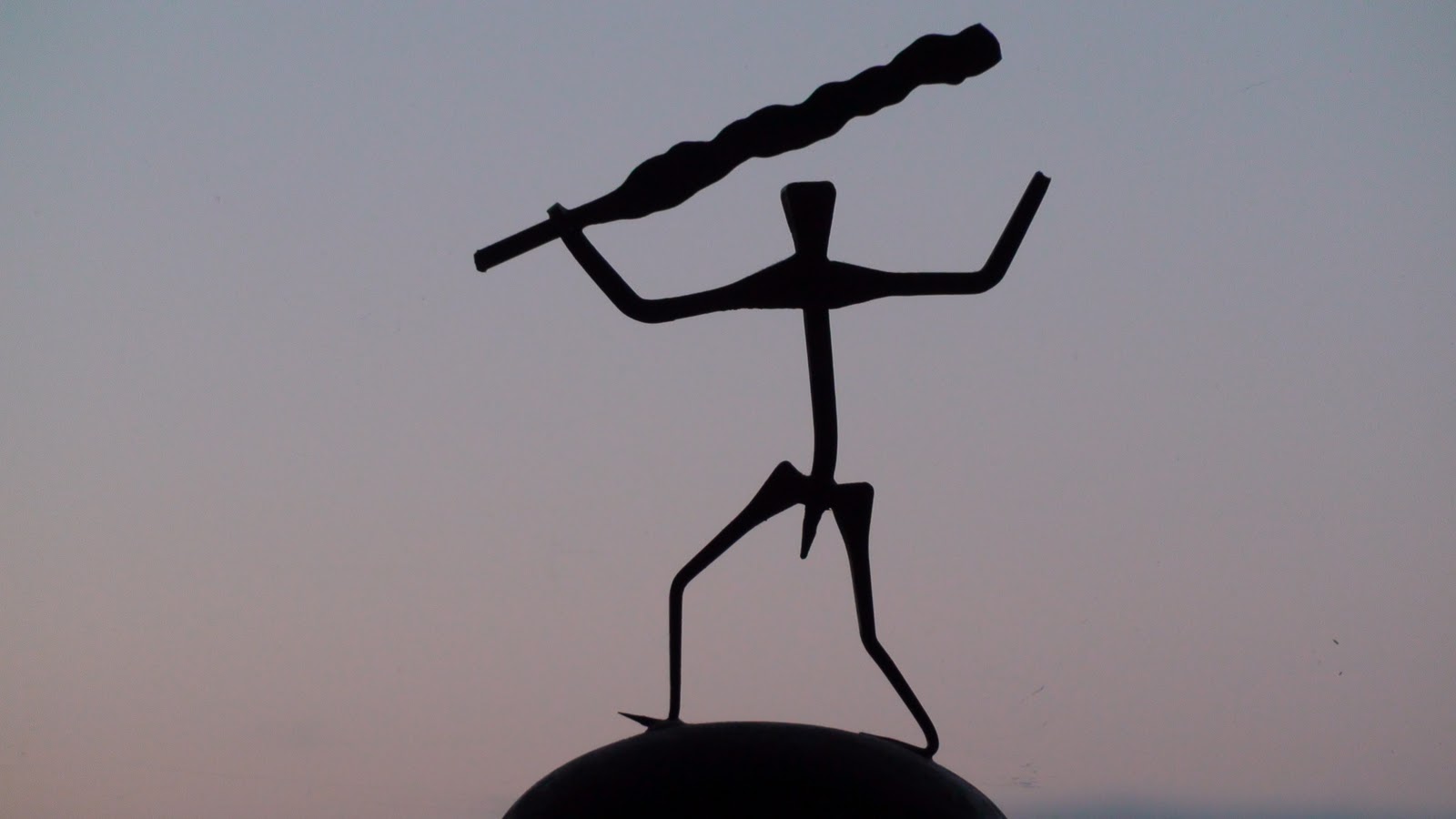
[Iron cast profile of the Cerne Abbas Giant]

Granted that my 'wee man' is not so excited as the ancient original; carved into chalk and measuring 180 feet on a Dorset hillside. However, he is certainly contented looking out over the ever changing light and water that is the Firth of Forth.   

For the Cerne Abbas Giant,

24 October 2010

Pliny on Man

1. " The nature of living creatures in the world is as important as the study of almost any other, even though the human mind is not able to pursue all aspects of the subject. Pride of place will rightly be given to one for whose benefit Nature apears to have created everything else. Her very many gifts, however, are bestowed as a cruel price, so that we cannot confidently say whether she is a good parent to mankind or a harsh stepmother." 

2. "Man is the only living creature whome nature covers with materials derived from others. To the remainder she gives different kinds of coverings - shell, bark, spines, hides, fur, bristles, hair, down, feathers, scales and fleeces. Even tree-trunks she protects from cold and heat by bark, sometimes in a double layer. But only man is cast forth on the day of his birth naked on the bare earth, to the accompanyment of crying and whimpering. No other creature is more given to tears - and that right at the begining of life. The well-known first smile occurs, at the earliest, only after forty days in any child."
4. "The early promise of strength and the first gift of time make him like a four-footed animal. When does man walk? When does he speak? When is his mouth firm enough for solid food? How long does his fontanelle pulsate - a sign that man is weakest amongst all living creatures? Then there are the diseases to which he is subject,  and the cures devised against these ills that are overcome by new maladies. All other animals know their own natures: some use speed, others swift flight, and yet others swimming. Man, however, knows nothing unless by learning - neither how to speak nor how to walk nor how to eat; in a word, the only thing he knows instinctivley is how to weep. ..."

5."Man alone of living creatures has been given grief, on him alone has luxury been bestowed in countless forms and through every single limb - and likewise ambition, greed and a boundless desire for living, superstitions, anxiety about burial ands even about what there will be after his life ends. No creature's life is more fragile; none has a greater lust for everything; none a more confused sense of fear or a fiercer anger. To sum up, other creatures gather and take thier stand against other species; ... But man, I swear, experiences most ills at the hands of his fellow men."

[Pliny The Elder, Natural History, VII.1-5]

28 September 2010

Loch Leven Castle, Kinross-shire

Ok, so this emperor has an obsession for visiting castles .... and I've never denied it.


Our most recent foray, took the imperial court to my home of Kinross-shire on the beautiful banks of Loch Leven. The small ferry boat carried us to the historical Castle Island; site of the famous stronghold that once served as a prison to the unhappy figure, Mary Queen of Scots .


Queen Mary's imprisonment (for a period of 288 days) was only broken by a dramatic night-time escape on 2nd May 1568. She was spirited away by boat, with the surreptitious help of the youth William Douglas, who stole the castle keys and locked her captors inside before discarding them into the loch.*
Its fair to say that Mary's stay at Lochleven Castle was an unhappy one and her later web posting on Trip-Advisor was less than complementary of its amenieties; a fact that must surley have led to the castle's current decline as a recreational retreat.
This Emperor's visit was lucky to catch a sunny day - one of those 'Last Days of Summer' gems that only September in Scotland can offer.
---------
*On the issue of the stolen castle keys: the 'Annals of Kinross-shire' make an interesting note that a rusted set of ancient and mighty keys were discovered by a local boy - William Honeyman - in the Autumn of 1805, during a period of particularly low water level for the Loch.

23 September 2010

Seneca on Stoicism & Restraint


"... indulge the body just so far as suffices for good health. It needs to be treated somewhat strictly to prevent it from being disobedient to the spirit. Your food should appease your hunger, your drink quench your thirst, your clothing keep out the cold, your house be a protection against inclement weather. It makes no difference whether it is built of turf or variegated marble imported from another country: what you have to understand is that thatch makes a person just as good a roof as gold does. Spurn everything that is added on by way of decoration and display by unnecessary labour. Reflect that nothing merits admiration except the spirit, the impressiveness of which prevents it from being impressed by anything."

[Seneca, Letters VIII.2]

Image of An Emperor: Domitian


"He was tall in stature, his countenance modest, and inclined to rudeness, with large eyes, though his sight was dim. His presence was graceful and comely, especially in his youth, excepting only that his toes were bent slightly inward. In course of time, he became disfigured by baldness, corpulence and the slenderness of his legs which were reduced by a long illness."

[Suetonius, Domitian, 18]