6 August 2012

For those About to Merchandise ... We Salute You!

This Summer the Emperor was fortunate to attend the great and ancient Olympic games hosted by the city of Londinium ....


A seat close to the mighty Olympic flame was an added enjoyment. A great time was had by the imperial court, although the Emperor could not fail to note a distinct lack of bloodshed. Still, "When in London ..." as they saying goes. 


7 July 2012

Tiberius on Flattery


"He so loathed flattery that he would not allow any senator to approach his litter, either to pay his respects or on business, and when an ex-consul in apologising to him attempted to embrace his knees, he drew back in such haste that he fell over backward. In fact, if anyone in conversation or in a set speech spoke of him in too flattering terms, he did not hesitate to interrupt him, to take him to task, and to correct his language on the spot. Being once called "Lord," he warned the speaker not to address him again in an insulting fashion. When another spoke of his "sacred duties," and still another said that he appeared before the senate "by the emperor's authority," he forced them to change their language, substituting "advice" for "authority" and "laborious" for "sacred."

[Suetonius, Life of Tiberius, 27]

3 July 2012

Highland Campaigning

Like great Roman generals before him,* the Emperor recently undertook a campaign into the remote Northern Highlands.

It has to be said that the Emperor's recent expedition was of a more recreational than military bent, but the terrain was certainly challenging and the Imperial forces camped under canvas like the armies of old.


Well, perhaps with a modicum of modern comfort, but it was camping none the less.


The troops were well provisioned; lacked for nothing in fact and the camp was in high spirits.

  
The beautiful beaches and strange characters found on them, were a wonder to the Emperor who had led his armies to the farthest and uncharted shores of the North.

A long and arduous progression through the most mountainous of terrain, saw the Emperor safely marshal his forces back to civilisation.

  
-------------------------------------
*One is reminded of of the Roman general Agricola , who in c.82AD made a concerted attempt to subdue the Northern lands of the Caledonian Tribes. Its fair to say the locals were not cooperative:

"We, the choicest flower of Britain's manhood, were hidden away in her most secret places. Out of sight of subject shores, we kept even our eyes free from the defilement of tyranny. We, the most distant dwellers upon earth, the last of the free, have been shielded till today by our very remoteness and by the obscurity in which it has shrouded our name. Now, the farthest bounds of Britain lie open to our enemies; and what men know nothing about they always assume to be a valuable prize. But there are no more nations beyond us; nothing is there but waves and rocks ... "
 
[Tacitus, Agricola, 30. Dramatic words of the Caledonian War Chief Calgacus, as imagined by the Historian Tacitus]


24 June 2012

Seeking The Right Direction

[Weather vane - Linlithgow]

It can serve us all to pause and reflect, before deciding on the right direction. 

What feels like the right way in life can indeed lead us far from our true path and what feels unsure can in turn emerge as out most authentic destination.   

13 June 2012

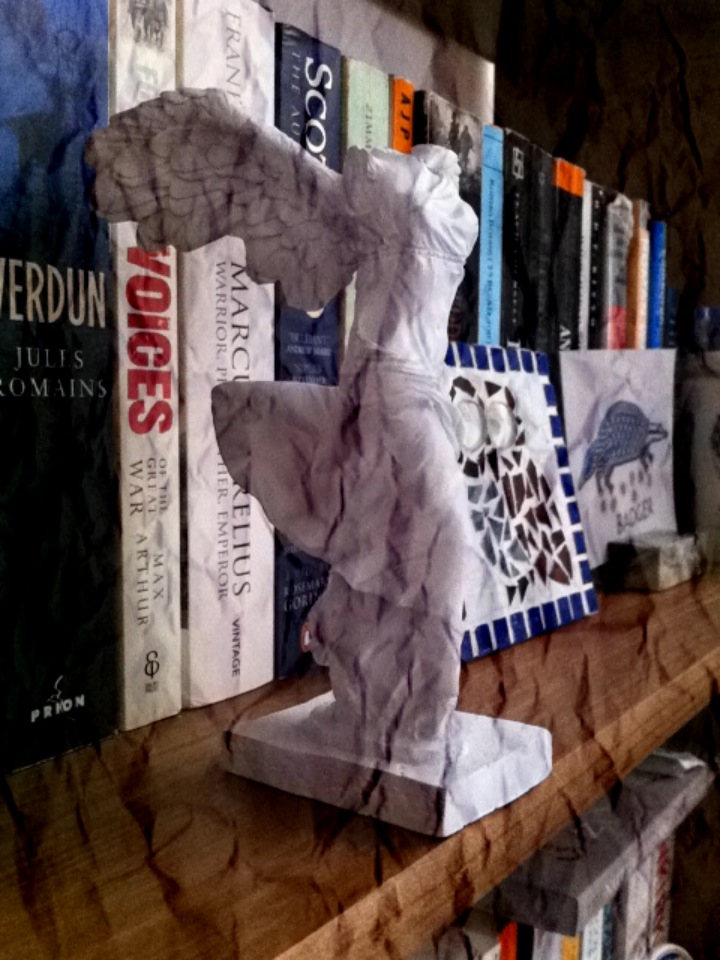
Shelf Life: The Winged Victory of Samothrace

[The Winged Victory of Samothrace]

--------------------
The Emperor was recently gifted an object of great esteem that now occupies a position of honour on the Imperial bookshelves.

This classical gift was brought back by a member of the Imperial house who recently undertook a cultural pilgrimage to the great Gallic city of Lutetia - modern day Paris.


The emperor's brother; seeking to emulate the wisdom of the esteemed Marcus Aurelius. Louvre Museum, Paris.  


For the Winged Victory of Samothrace see: http://en.wikipedia.org/wiki/Winged_Victory_of_Samothrace 

16 May 2012

Foreign Warships

[Foreign Warships in the Port of Leith, Edinburgh - May 2012]

"When they [the Romans] saw that the war was dragging on, they undertook for the first time to build ships, a hundred quinqueremes and twenty triremes. As their shipwrights were absolutely inexperienced in building quinqueremes, such ships never having been in use in Italy, the matter caused them much difficulty, and this fact shows us better than anything else how spirited and daring the Romans are when they are determined to do a thing."

"It was not that they had fairly good resources for it, but they had none whatever, nor had they ever given a thought to the sea; yet when they once had conceived the project, they took it in hand so boldly, that before gaining any experience in the matter they at once engaged the Carthaginians who had held for generations undisputed command of the sea. Evidence of the truth of what I am saying and of their incredible pluck is this."
 
"When they first undertook to send their forces across to Messene not only had they not any decked ships, but no long warships at all, not even a single boat, and borrowing fifty-oared boats and triremes from the Tarentines and Locrians, and also from the people of Elea and Naples they took their troops across in these at great hazard."

"On this occasion the Carthaginians put to sea to attack them as they were crossing the straits, and one of their decked ships advanced too far in its eagerness to overtake them and running aground fell into the hands of the Romans."


'This ship they now used as a model, and built their whole fleet on its pattern; so that it is evident that if this had not occurred they would have been entirely prevented from carrying out their design by lack of practical knowledge."


[Polybius, Histories, Book I.20.9-20]


-----------------------------------------------


29 April 2012

To Be An Emperor: Galba

[Galba:  one of the short-lived 'pretenders' of AD 69 that ultimately failed to succeed Nero]


"Rome is not like primitive countries with their kings. Here we have no ruling caste dominating a nation of slaves. You are called to be the leader of men who can tolerate neither total slavery nor total liberty."

[Tacitus, Histories, I.16]

The imperial usurper Galba's advice to his prospective heir, Piso - as put into words, by the cynical historian Tacitus.

-------

The sentiment reminds us that the position of a Roman Emperor was far from simple, or indeed, comfortable. Imperial stability required a powerful and largely autocratic ruler. And yet Roman sensibility, as moulded by many centuries of Republican and distinctly xenophobic prejudice, would not tolerate even the semblance of a tyrant. Or even worse, a derided foreign King!  

It was a bitterly ironic paradox; the lack of understanding of which proved the undoing of Caesar, Caligula and Nero.

"I am Caesar, and no King"

[Suetonius, Life of Julius Caesar, 79]
To little, too late, proved the unconvincing protestations of the great dictator ... and he paid for his mistake on the floor of the Senate House.

-------

Despite commanding (or at least seeming to command) the semblance of absolute power and spectacular wealth, the stability and security of an Emperor's rule, was always a complex and delicate affair. In the broadest of human terms, the Stoic wisdom of Seneca recognised that we should not automatically envy those in lofty positions. Not when we consider that:

"... what look like towering heights are indeed precipices.  ... there are many who are forced to cling to their pinnacle because they cannot descend without falling ... they are not so much elevated as impaled." 

[Seneca, Dialogues: On Tranquillity of Mind, 10 ]

To wear the Imperial purple was without doubt the most lofty of such pinnacles; and a descent from its heights, even for those few who it might be argued genuinely sought it, was riven with dangers that were all but insurmountable.

-------

For State, a relinquishment of imperial rule risked a return to the bitter murder and incessant civil war that had so blighted the last ages of the Republic. For the ruler who would so relinquish that power, the risk was total oblivion. As Octavian himself considered before the establishment of the very Principate:

"The question we are considering is not a matter of seizing hold of something, but of resolving not to lose it and thus expose [ourselves] to further danger. For you will not be forgiven if you thrust the control of affairs into the hands of the populace, or even if you entrust it to some other man. Remember that many have suffered at your hands, that virtually all of them will lay claim to sovereign power and that none of them will be willing to let you go unpunished for your actions or survive as a rival."     
[Cassius Dio, Roman Histories, LII.17]

Thus was it a somewhat reluctant Emperor [Tiberius] who had deftly perceived that to rule Rome was indeed like:

"... holding a wolf by the ears."

[Suetonius, Life of Tiberius, 25]

An Emperor was only safely in control, in so long as he held the power and guile not to release the unpredictable and savage animal that he so sought to dominate. Fail to dominate that savage animal and he was as good as dead. 

---------  

To the casual observer a Roman Emperor seemed all powerful, but ever was his position actually vulnerable and fraught with threat.  To rule was inherently dangerous and yet to relinquish rule could be more dangerous still. What looked like towering heights, were indeed, precipices for some ....