13 June 2012

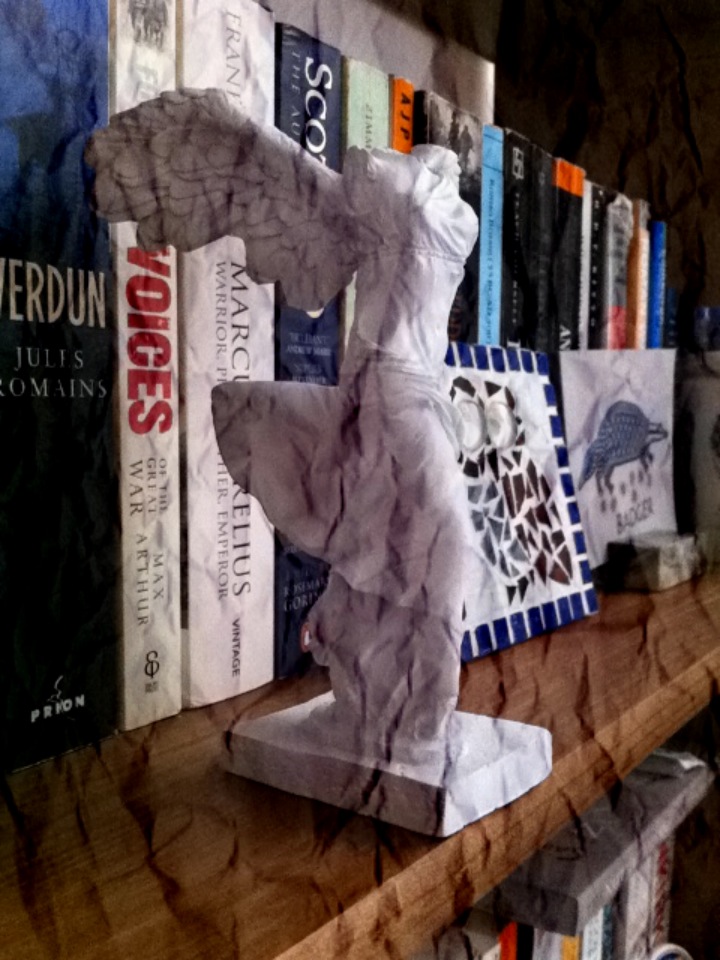
Shelf Life: The Winged Victory of Samothrace

[The Winged Victory of Samothrace]

--------------------
The Emperor was recently gifted an object of great esteem that now occupies a position of honour on the Imperial bookshelves.

This classical gift was brought back by a member of the Imperial house who recently undertook a cultural pilgrimage to the great Gallic city of Lutetia - modern day Paris.


The emperor's brother; seeking to emulate the wisdom of the esteemed Marcus Aurelius. Louvre Museum, Paris.  


For the Winged Victory of Samothrace see: http://en.wikipedia.org/wiki/Winged_Victory_of_Samothrace 

16 May 2012

Foreign Warships

[Foreign Warships in the Port of Leith, Edinburgh - May 2012]

"When they [the Romans] saw that the war was dragging on, they undertook for the first time to build ships, a hundred quinqueremes and twenty triremes. As their shipwrights were absolutely inexperienced in building quinqueremes, such ships never having been in use in Italy, the matter caused them much difficulty, and this fact shows us better than anything else how spirited and daring the Romans are when they are determined to do a thing."

"It was not that they had fairly good resources for it, but they had none whatever, nor had they ever given a thought to the sea; yet when they once had conceived the project, they took it in hand so boldly, that before gaining any experience in the matter they at once engaged the Carthaginians who had held for generations undisputed command of the sea. Evidence of the truth of what I am saying and of their incredible pluck is this."
 
"When they first undertook to send their forces across to Messene not only had they not any decked ships, but no long warships at all, not even a single boat, and borrowing fifty-oared boats and triremes from the Tarentines and Locrians, and also from the people of Elea and Naples they took their troops across in these at great hazard."

"On this occasion the Carthaginians put to sea to attack them as they were crossing the straits, and one of their decked ships advanced too far in its eagerness to overtake them and running aground fell into the hands of the Romans."


'This ship they now used as a model, and built their whole fleet on its pattern; so that it is evident that if this had not occurred they would have been entirely prevented from carrying out their design by lack of practical knowledge."


[Polybius, Histories, Book I.20.9-20]


-----------------------------------------------


29 April 2012

To Be An Emperor: Galba

[Galba:  one of the short-lived 'pretenders' of AD 69 that ultimately failed to succeed Nero]


"Rome is not like primitive countries with their kings. Here we have no ruling caste dominating a nation of slaves. You are called to be the leader of men who can tolerate neither total slavery nor total liberty."

[Tacitus, Histories, I.16]

The imperial usurper Galba's advice to his prospective heir, Piso - as put into words, by the cynical historian Tacitus.

-------

The sentiment reminds us that the position of a Roman Emperor was far from simple, or indeed, comfortable. Imperial stability required a powerful and largely autocratic ruler. And yet Roman sensibility, as moulded by many centuries of Republican and distinctly xenophobic prejudice, would not tolerate even the semblance of a tyrant. Or even worse, a derided foreign King!  

It was a bitterly ironic paradox; the lack of understanding of which proved the undoing of Caesar, Caligula and Nero.

"I am Caesar, and no King"

[Suetonius, Life of Julius Caesar, 79]
To little, too late, proved the unconvincing protestations of the great dictator ... and he paid for his mistake on the floor of the Senate House.

-------

Despite commanding (or at least seeming to command) the semblance of absolute power and spectacular wealth, the stability and security of an Emperor's rule, was always a complex and delicate affair. In the broadest of human terms, the Stoic wisdom of Seneca recognised that we should not automatically envy those in lofty positions. Not when we consider that:

"... what look like towering heights are indeed precipices.  ... there are many who are forced to cling to their pinnacle because they cannot descend without falling ... they are not so much elevated as impaled." 

[Seneca, Dialogues: On Tranquillity of Mind, 10 ]

To wear the Imperial purple was without doubt the most lofty of such pinnacles; and a descent from its heights, even for those few who it might be argued genuinely sought it, was riven with dangers that were all but insurmountable.

-------

For State, a relinquishment of imperial rule risked a return to the bitter murder and incessant civil war that had so blighted the last ages of the Republic. For the ruler who would so relinquish that power, the risk was total oblivion. As Octavian himself considered before the establishment of the very Principate:

"The question we are considering is not a matter of seizing hold of something, but of resolving not to lose it and thus expose [ourselves] to further danger. For you will not be forgiven if you thrust the control of affairs into the hands of the populace, or even if you entrust it to some other man. Remember that many have suffered at your hands, that virtually all of them will lay claim to sovereign power and that none of them will be willing to let you go unpunished for your actions or survive as a rival."     
[Cassius Dio, Roman Histories, LII.17]

Thus was it a somewhat reluctant Emperor [Tiberius] who had deftly perceived that to rule Rome was indeed like:

"... holding a wolf by the ears."

[Suetonius, Life of Tiberius, 25]

An Emperor was only safely in control, in so long as he held the power and guile not to release the unpredictable and savage animal that he so sought to dominate. Fail to dominate that savage animal and he was as good as dead. 

---------  

To the casual observer a Roman Emperor seemed all powerful, but ever was his position actually vulnerable and fraught with threat.  To rule was inherently dangerous and yet to relinquish rule could be more dangerous still. What looked like towering heights, were indeed, precipices for some ....
25 March 2012

Moving the Imperial Capital

Sometimes an Emperor is compelled to move his capital city.

Such an eventuality was undertaken in the reign of my great ancestor Constantine the Great.  In 330 A.D. Constantine undertook the decision to transfer the seat of Roman imperial power from ancestral Rome to the Eastern Greek city of Byzantium (Constantinople) in Asia Minor.

[The Emperor Constantine the Great: 274 - 337A.D.]

It was a momentous historical decision that saw the Eastern Empire ultimately flourish; preserving effective 'Roman' civilisation for centuries beyond the subsequent slow death and eventual collapse of the Western Roman Empire. *
-------

It was with such a glorious precedent in mind that the Emperor recently moved his own capital (in a Ford Transit van), also from West to the East.

[The Emperor moves home: March 2012]

From 18 miles West of Edinburgh back into the North of the city it was not an easy move, but the Emperor believes it was a prudent one.

No it was not pressure from barbarian incursion or civil strife that led to my moving of the imperial capital, but more modern pressures such as employment, commuting, and the elusive work-life balance ....   

The Emperor will consolidate his new seat of his power. The 'Athens of the North' (Edinburgh), shall once again become my new Rome ...

----------------

*Its an interesting footnote in this context to note that Rome - the remaining capital of Western Roman Empire -  was itself subsumed by the Northern Italian city of Ravenna, when in 402 A.D, Western power was transferred there by the Emperor Honorius. By this period in its fast fading glory the city of the Romans was no longer a viable or defensible capital.

11 March 2012

Cato the Elder

[Catus Marlicus, The Elder Statesman]

The ancient historian Plutarch tells us:

"The Romans used to call men who had no family distinction, but were coming into public notice through their own achievements, "new men," and such they called Cato. But he himself used to say that as far as office and distinction went, he was indeed new, but having regard to ancestral deeds of valour, he was oldest of the old. His third name was not Cato at first, but Priscus. Afterwards he got the surname of Cato for his great abilities. The Romans call a man who is wise and prudent, catus. "

"As for his outward appearance, he had reddish hair, and keen grey eyes, as the author of the well-known epigram ill-naturedly gives us to understand:"

'Red-haired, snapper and biter, his grey eyes flashing defiance,
Porcius, come to the shades, back will be thrust by their Queen.'

[Plutarch, Life of Cato the Elder, 2-3]

4 March 2012

To Be An Emperor: Marcus Aurelius


"When you act, let it be neither unwillingly, nor selfishly, not unthinkingly, not half-heartedly; do not attempt to embellish your thoughts by dressing them up in fine language; avoid excessive talk and superfluous action. Furthermore, let the deity within you be the overseer of one who is manly and mature, a statesman, a Roman and a ruler, who has taken his post as one who is awaiting the signal of his recall from life and is ready to obey without need of an oath or another man as his witness. And show a cheerful face to the world, and have no need of help from outside or the peace that others confer. In brief, you must stand upright, not be held upright"

[Marcus Aurelius, Meditations, III.5]

-----------------------

Extract from the 'Meditations', by the Emperor, Marcus Aurelius [ruled 161-180 AD]. Self written notes written in the Stoic philosophy as a means of providing self-guidance and grounding to his own rule and conduct.